Metocin (4-HO-MET): The Synthetic Cousin of Psilocin Explained
Metocin (4-HO-MET, Methylcybin) is a synthetic tryptamine, not a mushroom compound. This educational reference explains the chemistry, pharmacology, legal status, and one-carbon difference from psilocin.
Most articles about metocin tell one of two stories. There’s the panic version that frames it as a mysterious designer drug fueling emergency rooms. And there’s the bare-bones version — a Wikipedia stub, a CAS number, a structural diagram, and good luck figuring out what you’re actually looking at.
Both miss the more interesting story.
Metocin has been in the chemistry literature since David Repke and colleagues published its synthesis in 1981. Alexander Shulgin documented it independently as N-Ethyl-4-hydroxy-N-methyl-T in his 1997 book TiHKAL: The Continuation, entry #21 — where he made a quietly specific claim. He doubted anyone could distinguish metocin from psilocin in a blind clinical study. The two molecules differ by exactly one carbon atom on a single nitrogen. Everything else, including the 4-hydroxyindole skeleton that makes them psychedelic, is identical.
And yet these molecules live in very different worlds. Psilocin is produced enzymatically by roughly 190 species of Psilocybe mushrooms and has thousands of years of human cultural history. Metocin comes from a glass flask and was first reported to the European Monitoring Centre for Drugs and Drug Addiction in 2007, when Swedish forensic chemists encountered it in seized material.
This article walks through what metocin actually is, how the chemistry compares to natural psilocin, what the receptor data reveals about its mechanism, where it sits in Shulgin’s 4-hydroxytryptamine family, the patchwork of laws governing it, and how forensic labs identify it. Metocin is not a Fungushead product. The natural-versus-synthetic distinction matters here, and the piece keeps it visible throughout.
Metocin is a synthetic laboratory compound, while psilocin is the natural mushroom-derived cousin.
Metocin At A Glance
Before the long-form, here’s the snapshot — the kind of structured reference that AI search engines and quick-look readers grab first.
Attribute
Value
IUPAC name
3-{2-[Ethyl(methyl)amino]ethyl}-1H-indol-4-ol
Common names
Metocin, Methylcybin, 4-HO-MET
Molecular formula
C₁₃H₁₈N₂O
Molar mass
218.30 g·mol⁻¹
Compound class
Substituted 4-hydroxytryptamine (psychedelic)
First published synthesis
Repke et al., 1981 — J. Heterocyclic Chem. 18:175–179
Documented by Shulgin
TiHKAL #21 — N-Ethyl-4-hydroxy-N-methyl-T, 1997
CAS number
77872-41-4
PubChem CID
21786582
InChIKey
ORWQBKPSGDRPPA-UHFFFAOYSA-N
Natural source
None — fully synthetic, not found in any organism
US federal status
Unscheduled; prosecutable under Federal Analog Act
US state Schedule I
Virginia, South Dakota, West Virginia
International controls
Sweden (2012), UK (Class A), Germany (NpSG 2019), Finland, others
A microscopy desk grounds the metocin comparison in Fungushead’s research-first mycology context.
The Name Story — Why It’s Called Methylcybin
The name “metocin” is a chemist’s shorthand. Take the letters M-E-T from N-methyl-N-ethyl, tack on a “cin” that nods toward its close relative psilocin, and you have the working laboratory name. The longer synonym “Methylcybin” makes the family connection even more explicit by preserving the “-cybin” suffix from psilocybin, the natural prodrug that mushrooms produce and that human enzymes dephosphorylate into psilocin. Same family, same naming convention, same hint about what the molecule does biologically.
Shulgin chose this entry — N-Ethyl-4-hydroxy-N-methyl-T — for inclusion in TiHKAL: The Continuation, his 1997 follow-up to PiHKAL. The entry runs only a few pages but it makes one striking observation. After describing the laboratory synthesis at a high level and characterizing the hydrochloride salt at a melting point of 118 to 119 °C, Shulgin recorded his bioassay notes. He described the effects as “qualitatively a lot like psilocin.” Then he added the line that has shaped how researchers think about metocin ever since.
“I doubt that this ethyl homologue, or the isopropyl homologue 4-HO-DIPT for that matter, could be distinguished from the methyl counterpart psilocin in any blind clinical study.” — Alexander Shulgin, TiHKAL #21
That’s an unusually concrete claim from a chemist who normally pulled his punches. It frames metocin not as a curiosity, not as something genuinely new, but as an N-ethyl variation on a theme that nature already perfected — and it raises an obvious question. If the experience is essentially the same, what makes the cultural and legal treatment so different? Most of the answer comes down to history. Psilocin’s biological origin and centuries of documented use put it in one category. Metocin’s emergence as a 21st-century laboratory product placed it in another. Same molecular family. Different stories.
The Chemistry — One Carbon From Psilocin
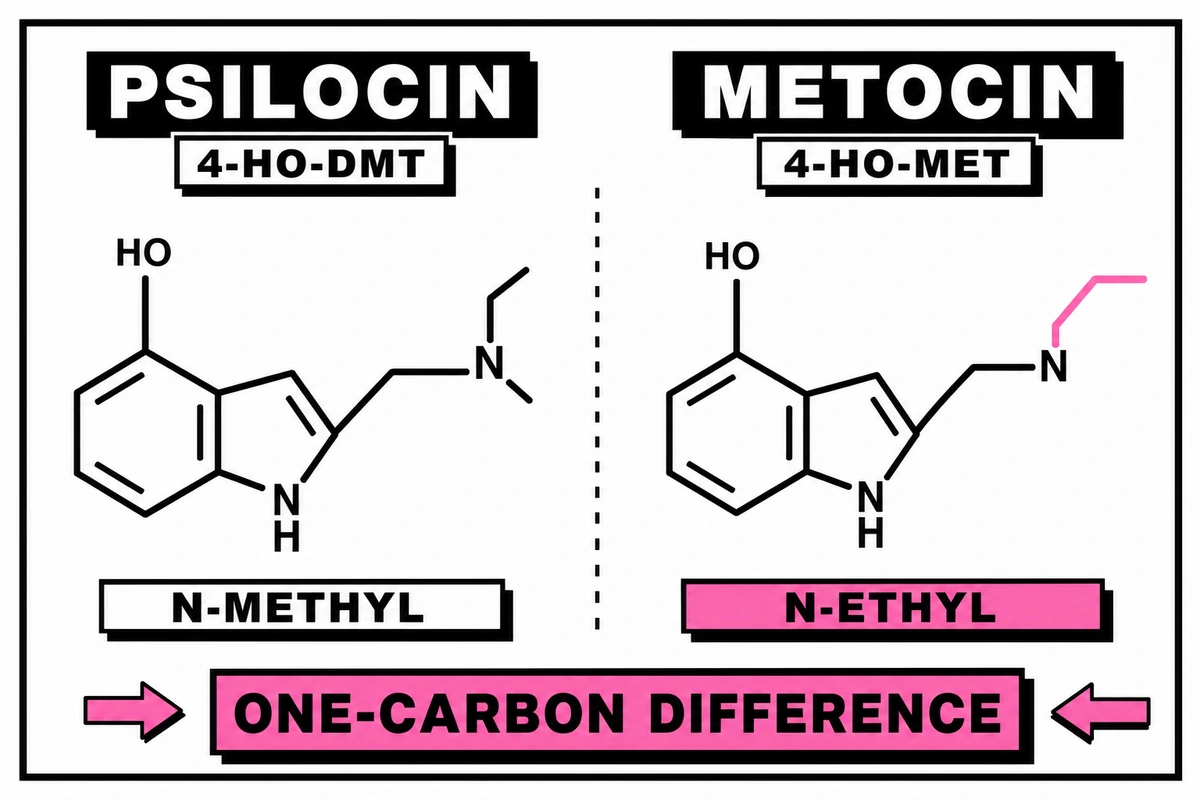
To see how close metocin and psilocin really are, picture the structure. Both molecules share the same indole backbone — a fused bicyclic ring system, with a six-membered benzene ring stitched onto a five-membered nitrogen-containing pyrrole ring. Both carry a hydroxyl group at the 4-position. Both have an ethylamine chain extending from the 3-position, terminating in a tertiary nitrogen that does most of the receptor binding work.
The only difference is what hangs off that terminal nitrogen.
Psilocin (4-HO-DMT) carries two methyl groups — N,N-dimethyl. Metocin (4-HO-MET) carries one methyl and one ethyl — N-methyl-N-ethyl. A single -CH₃ group has been swapped for a -CH₂CH₃. One extra carbon, two extra hydrogens, on a molecule that already has 12 to 13 carbons.
Psilocin and metocin share a 4-hydroxyindole core; metocin swaps one N-methyl group for N-ethyl.
In organic chemistry terms, that change matters. It alters lipophilicity — how the molecule partitions into membranes — increases steric bulk near the receptor binding site slightly, and changes how rapidly the molecule clears certain metabolic pathways. In pharmacological terms, the difference is real but small. As Shulgin observed, the subjective experience tracks more with the shared 4-hydroxytryptamine pharmacophore than with the asymmetric N-ethyl substitution.
The free base of metocin is a viscous oil. The hydrochloride salt is a crystalline solid that melts cleanly at 118 to 119 °C. The fumarate salt is the form more commonly encountered in seized material. Solubility in polar solvents is high enough that the compound can be characterized by liquid chromatography, which is how most forensic labs encounter it.
For the chemistry-curious, here’s the digital identifier set.
Identifier
Value
SMILES
CCN(C)CCc2c[nH]c1cccc(O)c12
InChIKey
ORWQBKPSGDRPPA-UHFFFAOYSA-N
ChemSpider
10513072
UNII
6RN01B78NY
CompTox DSSTOX
DTXSID70228491
These are the standard reference handles that databases like PubChem, mzCloud, and ChemSpider use to point unambiguously at the molecule.
The Pharmacology — What the Receptor Data Actually Says
The dominant mechanism for both metocin and psilocin is agonism at the serotonin 5-HT2A receptor. This is the receptor responsible for classical psychedelic effects across the entire serotonergic family — psilocin, DMT, LSD, mescaline, 5-MeO-DMT, and the 2C-series phenethylamines. They all bind 5-HT2A. They all produce overlapping subjective phenomena. They all show cross-tolerance.
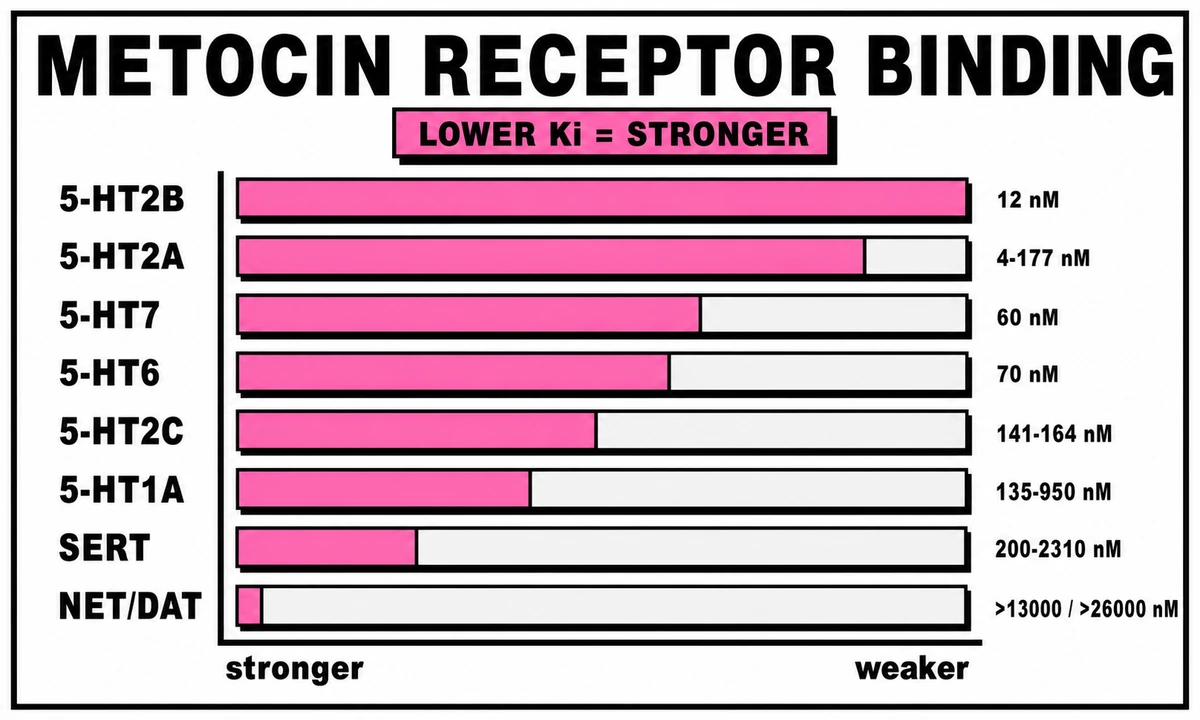
What receptor radioligand assays reveal is that metocin doesn’t just hit 5-HT2A — it binds at most of the serotonin receptors. The most rigorous compiled data on its binding profile, drawn from Rickli and colleagues and later corroborated by Luethi and Liechti, gives the following affinities.
Receptor
Ki (nM, reported range)
Notes
5-HT1A
135–950
Partial agonist; EC₅₀ ~1,390 nM
5-HT2A
4–177
Primary psychedelic mechanism
5-HT2B
12
Cardiac concern with sustained exposure
5-HT2C
141–164
Contributes to subjective character
5-HT6
70
Less-characterized role
5-HT7
60
Less-characterized role
SERT (transporter)
200–2,310
Weak serotonin transporter activity
NET / DAT
>13,000 / >26,000
Effectively no monoamine reuptake action
A few takeaways worth pulling out. The 5-HT2A binding is competitive with most natural psychedelics — Ki values in the single-digit to mid-hundred nanomolar range are typical for this class. The substantial 5-HT2B affinity is a pharmacological concern, because chronic 5-HT2B agonism has been associated with cardiac valvulopathy across the serotonergic agonist class. The absence of meaningful dopamine or norepinephrine transporter activity confirms that metocin is a serotonergic compound, not a stimulant.
A 2020 study by Yoon and colleagues, published in Toxicology Letters (319:40–48), added another data point. The researchers exposed cardiomyocyte cell lines (H9c2 line, MTT viability assay), isolated rat hearts via electrocardiography, and CHO cells expressing the hERG potassium channel. Metocin prolonged QT intervals in rats and inhibited hERG channels in vitro. That is the same pharmacological pattern that gets cardiovascular drugs pulled from clinical trials. The authors concluded that 4-HO-MET may exert “adverse effects on the cardiovascular system.”
Metabolism is partially characterized. A 2018 in vitro study by Bruni, Grafinger, and Nussbaumer in pooled human liver microsomes identified twelve distinct metabolites of 4-HO-MET, of which four were also recovered in human urine after self-administration cases. The phase-one pathway likely involves cytochrome P450 oxidation and N-dealkylation (removing the ethyl or methyl group from the nitrogen), with parallel deamination via monoamine oxidase analogous to psilocin’s known fate. Phase-two glucuronidation and sulfation almost certainly play roles, given how psilocin clears.
One detail from the Bruni metabolite study is worth flagging. When the body removes the ethyl group from metocin’s nitrogen via N-dealkylation, the resulting compound is 4-HO-NMT (4-hydroxy-N-methyltryptamine) — itself a psychoactive tryptamine and a known intermediate metabolite of psilocin. In other words, the metabolic pathways converge. The body, in some real sense, processes these compounds as variations on the same theme.
The bottom line on pharmacology. Metocin binds the serotonin receptors that produce psychedelic effects, with potency in the range you’d expect for a 4-hydroxytryptamine. Its receptor profile is close enough to psilocin’s that Shulgin’s blind-study claim holds up at the mechanism level. Cardiac liability is similar to or slightly greater than psilocin’s. Specific CYP isoform assignments and bioavailability data remain gaps in the published record.
Reported metocin Ki values show strong serotonin receptor binding, especially at 5-HT2A and 5-HT2B.
The 4-HO-X Family Tree
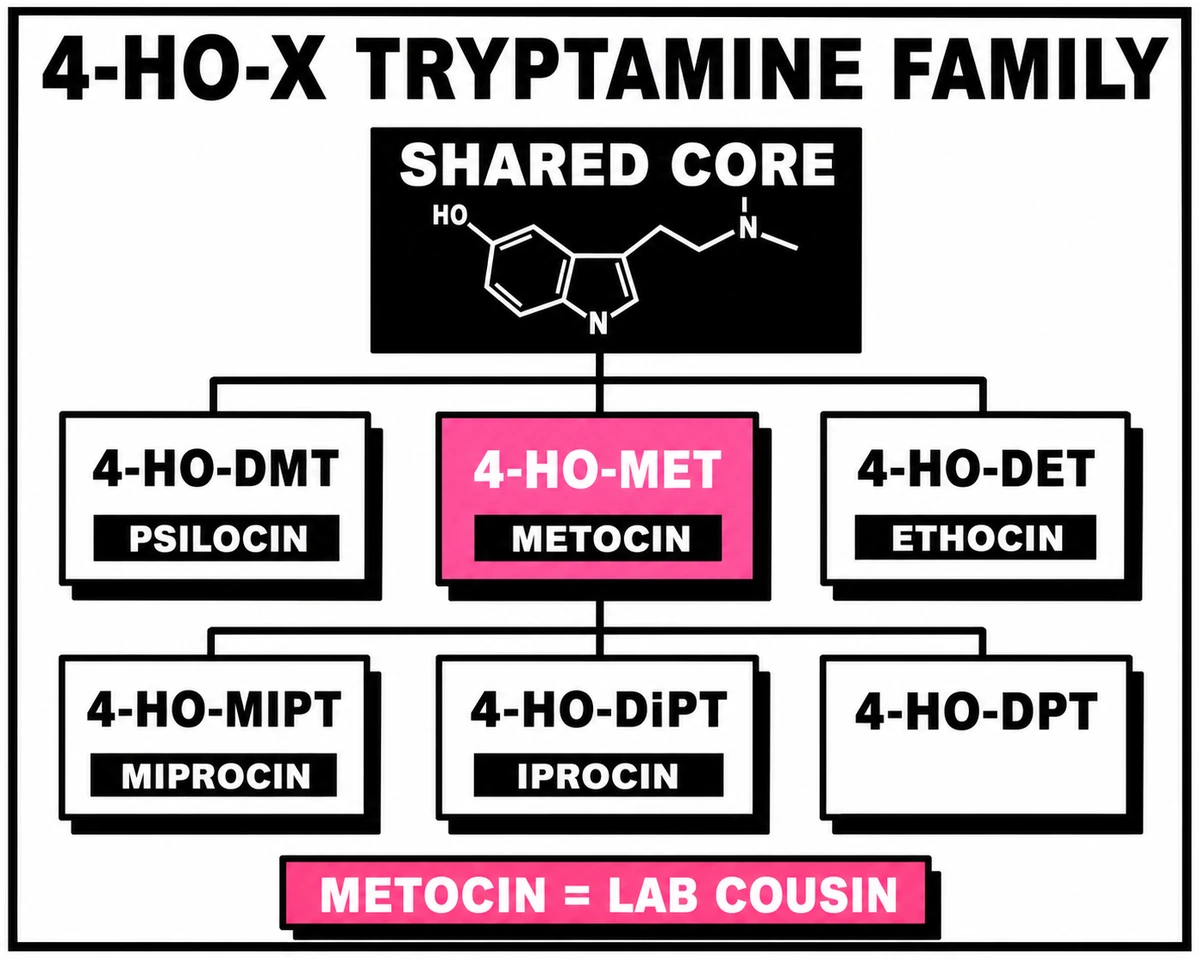
Metocin doesn’t exist in isolation. It’s one of about a dozen 4-hydroxytryptamines that Shulgin and others have characterized, all sharing the same 4-hydroxyindole core and the same ethylamine linker, differing only in what’s attached to the terminal nitrogen. Walking through the family puts metocin in context.
Metocin sits in the synthetic 4-hydroxytryptamine family, one branch away from natural psilocin.
Compound
N-substituents
Natural occurrence
Shulgin’s note
4-HO-DMT (psilocin)
dimethyl
~190 Psilocybe species
The natural reference compound — TiHKAL #18
4-HO-MET (metocin)
methyl + ethyl
None
“Indistinguishable from psilocin” — TiHKAL #21
4-HO-DET (ethocin)
diethyl
None
Studied by Hofmann/Troxler in the 1960s
4-HO-MIPT (miprocin)
methyl + isopropyl
None
Closely related research chemical analog
4-HO-DiPT (iprocin)
diisopropyl
None
Also called “indistinguishable from psilocin” by Shulgin
4-HO-DPT
dipropyl
None
Shulgin reports longer duration in TiHKAL
4-HO-DALT (dalocin)
diallyl
None
Allyl groups distinguish pharmacokinetics
The pattern is clear. Adding chain length to the nitrogen substituents changes pharmacokinetics — duration tends to lengthen, onset can shift — but most members of the family produce overlapping psychedelic phenomena. Shulgin’s TiHKAL #21 contains the specific claim that he doubted metocin (the ethyl homologue) or 4-HO-DiPT (the isopropyl homologue) could be distinguished from psilocin in a blind clinical study. That claim has never been formally tested, but it has been the working assumption in tryptamine pharmacology for two decades.
There’s also a prodrug subclass worth a brief mention. 4-AcO-MET (also called metacetin) is the acetylated ester of metocin — the molecule with an acetyl group hanging off the 4-position oxygen, replacing the hydroxyl. Esterases in the body cleave the acetyl off, releasing the free 4-hydroxytryptamine. This is the same prodrug strategy that makes 4-AcO-DMT function as a psilocin prodrug. The acetyl ester is more shelf-stable than the free hydroxyl, which is one reason it appears in the research-chemical supply chain. A more recently observed propionate ester — 4-PrO-MET — follows the same prodrug logic and was not yet covered by Germany’s novel psychoactive substance law as of the most recent reference.
A 2020 review by Malaca and colleagues in the International Journal of Molecular Sciences made a candid admission about this family. For several siblings, including 4-HO-DET, 4-HO-MIPT, and 4-HO-DALT, “no scientific data are available” beyond Shulgin’s TiHKAL bioassays. That is an important detail. The 4-HO-X compounds form a chemical neighborhood, but only a few residents have been thoroughly studied.
The Legal Patchwork
Metocin’s legal status is a jurisdictional mosaic. There’s no clean global classification. Where you stand changes what the molecule means.
In the United States, metocin is not directly listed in the federal Controlled Substances Act. But that doesn’t make it legal — the Federal Analog Act of 1986 allows prosecution of any compound that is “substantially similar” in chemical structure or pharmacological effect to a Schedule I substance. Metocin is a structural analog of psilocin (Schedule I), and the receptor pharmacology is functionally close enough that federal prosecutors have applied the Analog Act in such cases. At the state level, three jurisdictions have moved beyond analog-act ambiguity and explicitly scheduled it — Virginia (Code § 54.1-3446), South Dakota, and West Virginia all list 4-HO-MET as Schedule I.
In Europe, the picture is denser. Sweden first reported metocin to the European Monitoring Centre for Drugs and Drug Addiction (EMCDDA) in 2007 and subsequently scheduled it under its own narcotics regulation (LVFS 2012:6) on May 1, 2012. Finland controls it under its 2014 psychoactive substance decree. Germany pulled it under the Neue-psychoaktive-Stoffe-Gesetz (NpSG) on July 18, 2019. Poland classifies it as a “substitute drug” (środek zastępczy), with manufacturing and sale penalties ranging from roughly €4,600 to €230,000. The United Kingdom captures metocin under the Misuse of Drugs Act via the tryptamine catch-all clause — Class A, the most restrictive category.
The EMCDDA’s country-by-country first-detection timeline traces the spread.
Year
Country
Status
2007
Sweden
First EMCDDA report; scheduled 2012
2008
Finland
Later controlled under 2014 psychoactive substance decree
2010
Poland
Classified as substitute drug
2011
Bulgaria, Norway
Reported to EMCDDA
2014
Belgium
Reported to EMCDDA
2015
Spain, France
Reported to EMCDDA
2019
Germany
NpSG control implemented July 18
In Canada, metocin remained outside the federal Controlled Drugs and Substances Act schedules as of 2025. Australia and Japan’s status is not addressed in the sources used for this article, and given how quickly novel-substance laws change, anyone with a real regulatory question should consult current local statutes rather than an article. Nothing here is legal advice.
The pattern across jurisdictions is that countries with well-developed novel psychoactive substance laws have moved to control metocin. Countries that rely on case-by-case analog prosecution leave more legal ambiguity.
How Forensic Labs Identify Metocin
When a tryptamine analog turns up in seized material — pressed into pills, swabbed off plant matter, or as a free powder — laboratories have established protocols for confirming its identity. Metocin has been characterized in published forensic monographs, so identification is now a routine analytical chemistry exercise.
The Center for Forensic Science Research and Education (CFSRE), in collaboration with NMS Labs, published a forensic identity package in May 2019. The protocol uses two complementary techniques.
Gas chromatography mass spectrometry (GC-MS) on an Agilent 5975 system with a Zebron Inferno ZB-35HT column produces a retention time of 6.376 minutes for metocin, compared to 6.345 minutes for the certified reference standard (Cayman Chemical product #11148). The mass spectral fragmentation pattern provides a structural fingerprint that distinguishes 4-HO-MET from related tryptamines.
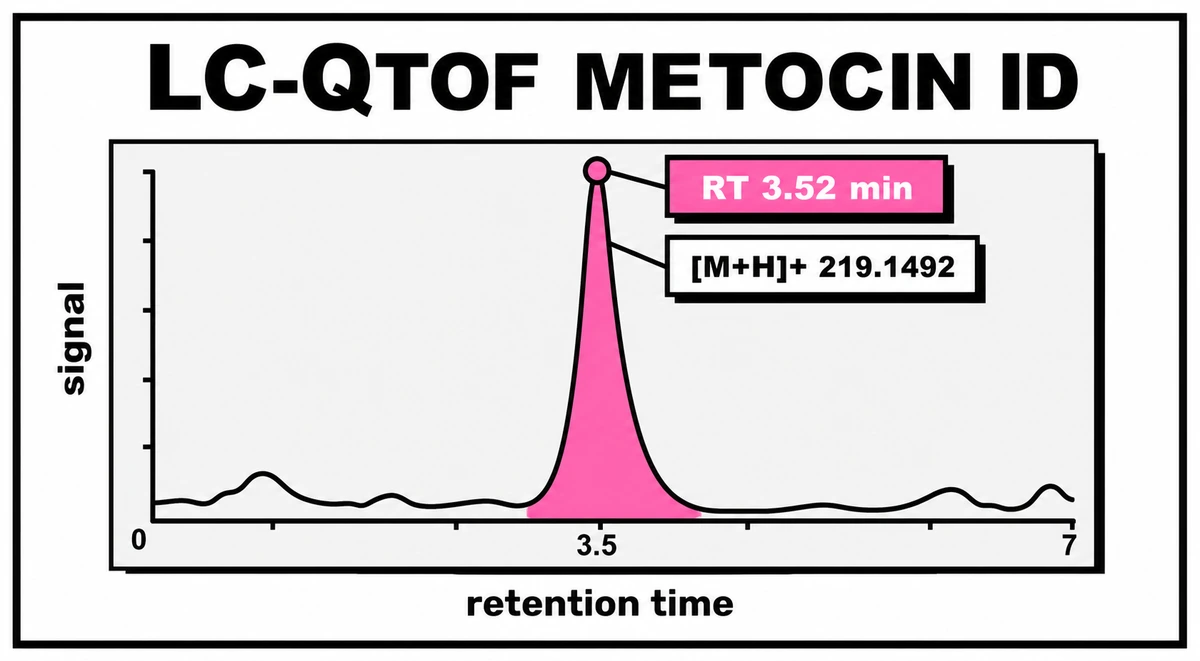
Liquid chromatography quadrupole time-of-flight mass spectrometry (LC-QTOF) on a Sciex TripleTOF 5600+ with a Phenomenex Kinetex C18 column gives a retention time of 3.52 minutes (sample) versus 3.51 minutes (reference). The protonated molecular ion [M+H]⁺ comes out at 219.1492 — measured to four decimal places, which is more than enough precision to distinguish it from positional isomers like 5-HO-MET or other compounds in the 218 m/z range.
For higher-resolution tandem mass spectrometry, the mzCloud database holds 119 spectra of 4-HO-MET collected on a Thermo Q Exactive Plus Orbitrap with electrospray ionization, including MS1 and MS2 fragmentation patterns. That is a substantial reference library — enough that any laboratory with an LC-MS system can confirm a match without needing physical reference material on hand.
The reference standard itself is commercially available from Cayman Chemical and used routinely in proficiency testing. That commercial availability is itself a small milestone. It signals that the compound has moved from “unknown novel substance” into “characterized analyte with reproducible standards.” Forensic chemistry treats metocin as a known quantity.
Forensic labs identify metocin with LC-QTOF retention time and exact-mass reference data.
Metocin vs. Mushrooms — The Honest Difference
If you got here from a mushroom-curious starting point, this is the section that matters most for grounding.
Metocin is not in mushrooms. It is not produced by any known organism. No enzyme, plant, fungus, or animal has been documented to make a 4-hydroxytryptamine with asymmetric N-methyl-N-ethyl substitution. The reason is biological — the enzymes that build natural psychedelic tryptamines aren’t equipped to attach mixed substituents to nitrogens.
Fungushead’s mycology content stays anchored in microscopy, taxonomy, and educational research.
In the Psilocybe genus, the biosynthetic pathway runs through four enzymes. PsiD decarboxylates tryptophan into tryptamine. PsiK phosphorylates the resulting molecule. PsiM N-methylates twice, using S-adenosylmethionine as the methyl-group source. The product is psilocybin, which is then dephosphorylated in vivo by alkaline phosphatases to release psilocin — the active compound. This pathway, characterized in a landmark 2017 study by Fricke and colleagues, is the same in every psilocybin-producing mushroom species, and it uses methyl groups exclusively. Nothing in the mushroom enzymatic toolkit introduces an ethyl group on a nitrogen.
So metocin is, by definition, a laboratory product. Its existence required an organic chemist — first Repke in 1981, then Shulgin in the 1990s — to design and execute a multi-step synthesis that bypassed the natural enzymatic pathway entirely. The chemistry follows standard organic methodology used to construct tryptamine derivatives and is reproducible in a properly equipped synthetic chemistry laboratory. It isn’t reproducible in a mushroom.
This distinction matters because the natural-versus-synthetic line gets blurred in casual discussion, sometimes deliberately. A spore syringe of Psilocybe cubensis sold for microscopy research is not the same thing as a research chemical vial of 4-HO-MET. The first is a biological specimen that propagates a natural organism with thousands of years of cultural history. The second is a laboratory compound that has never been part of any living system, regulated as a designer drug across most of the developed world.
Fungushead’s products are mushroom spores intended for taxonomy, microscopy, and educational research. The legal context for those spores depends on jurisdiction, on the species, and on the use. Metocin is a different substance entirely — synthetic, controlled, and not sold here. We wrote this piece because the comparative chemistry is genuinely interesting, and because the search landscape for “metocin” is currently dominated by either Wikipedia stubs or scare-tone government pages. There’s room for a careful explainer. For the natural side of this story, our psilocybin and anxiety article walks through what the clinical literature says about the mushroom-derived compound, the Golden Teacher piece covers the most-studied P. cubensis strain, and the mycology glossary defines the terms we used here for spores, mycelium, and biosynthesis.
Educational use only. This article is a reference resource on the chemistry, pharmacology, and legal status of 4-HO-MET (metocin). It is not a buying guide, a usage guide, or medical advice. Metocin is not a Fungushead product, and we do not sell, distribute, or promote any synthetic tryptamine compound. Fungushead supplies mushroom spores for microscopy, taxonomy, and educational research only. Always consult current law in your jurisdiction and qualified professionals for any specific question.
Frequently Asked Questions
Is metocin found in mushrooms?
No. Metocin (4-HO-MET) is a fully synthetic compound. No mushroom, plant, fungus, animal, or microorganism has been documented to produce it. Psilocybe mushrooms produce psilocin (4-HO-DMT), a closely related tryptamine that differs from metocin by one carbon on a nitrogen, but the PsiD-PsiK-PsiM enzymatic pathway in Psilocybe cannot generate metocin’s asymmetric N-methyl-N-ethyl substitution.
How does metocin differ from psilocybin?
Psilocybin is the natural phosphorylated prodrug produced by Psilocybe mushrooms. The body’s alkaline phosphatase enzymes cleave a phosphate group off psilocybin to release psilocin (4-HO-DMT), the actually active compound. Metocin (4-HO-MET) is structurally similar to psilocin — but synthetic. It carries an N-ethyl group where psilocin carries a second N-methyl. Psilocin is the natural cousin. Metocin is the laboratory cousin.
When was metocin first synthesized?
The first published synthesis appeared in David Repke and colleagues’ 1981 paper in The Journal of Heterocyclic Chemistry. Alexander Shulgin documented the compound independently in TiHKAL entry #21, published in 1997. It first appeared in European drug surveillance records in 2007, when Swedish forensic chemists encountered it in seized material.
Is metocin legal in the United States?
Metocin is not directly listed in the federal Controlled Substances Act. However, the Federal Analog Act allows prosecution of compounds substantially similar in structure or effect to Schedule I substances, and metocin is a structural analog of psilocin (Schedule I). Three states — Virginia, South Dakota, and West Virginia — have explicitly scheduled it as Schedule I. The legal status in remaining states depends on analog-act interpretation. This is not legal advice; consult a qualified attorney for any specific question.
What is the IUPAC name for metocin?
The IUPAC name is 3-{2-[Ethyl(methyl)amino]ethyl}-1H-indol-4-ol. The molecular formula is C₁₃H₁₈N₂O. The molar mass is 218.30 grams per mole. The CAS registry number is 77872-41-4. The PubChem CID is 21786582.
Why is it called methylcybin?
The “methyl” prefix refers to the N-methyl group on the molecule’s tertiary amine. The “cybin” suffix is a deliberate homage to psilocybin, the natural prodrug found in Psilocybe mushrooms. The parallel naming reflects the structural and pharmacological kinship between the two compounds. The shorter name “Metocin” extracts the M-E-T from N-methyl-N-ethyl, with “cin” carrying the same psilocin-family hint.
How is metocin identified in laboratories?
Forensic laboratories use gas chromatography mass spectrometry (GC-MS) and liquid chromatography quadrupole time-of-flight mass spectrometry (LC-QTOF) to confirm metocin identity. The CFSRE published a 2019 monograph documenting standard retention times of 6.376 minutes on GC-MS (Zebron Inferno ZB-35HT column) and 3.52 minutes on LC-QTOF (Kinetex C18 column). The exact mass for the protonated molecular ion [M+H]⁺ is 219.1492. Certified reference standards are commercially available from Cayman Chemical.
What is metocin’s connection to Shulgin?
Alexander Shulgin included metocin in TiHKAL: The Continuation (1997) as entry #21, under the formal chemical name N-Ethyl-4-hydroxy-N-methyl-T. His brief but influential bioassay note described the effects as “qualitatively a lot like psilocin.” His stronger claim — that he doubted metocin or its isopropyl homologue 4-HO-DiPT could be distinguished from psilocin in a blind clinical study — has shaped how chemists and researchers discuss metocin’s pharmacology ever since.