


If you’ve ever marveled at the intricate world of spores under a microscope, you know there’s something magical about preparing your own specimens. Creating a spore syringe isn’t just a technical skill—it’s your gateway to exploring the fascinating microscopic universe of fungal taxonomy. Today, I’m excited to walk you through everything you need to know to create professional-quality spore syringes for your microscopy studies.
Important Legal Notice: All spore syringes discussed in this guide are intended solely for microscopy, taxonomy, and educational research purposes. The information provided is for scientific study only.
What Is a Spore Syringe? Understanding Your New Research Tool
Let’s start with the basics. A spore syringe is essentially a sterile water suspension containing thousands of fungal spores, all neatly contained in a medical-grade syringe. Think of it as your precision tool for placing exactly the right amount of spores onto a microscope slide—no more fumbling with spore prints or making a mess on your workspace!
Now, here’s where it gets interesting: unlike liquid cultures (which contain living, growing mycelium), spore syringes hold only the reproductive spores themselves. This distinction matters because spores reveal unique genetic and structural details that you simply can’t observe in mycelial cultures. It’s like having seeds versus looking at a full-grown plant—both fascinating, but entirely different experiences under the microscope.
Why Scientists and Hobbyists Love Working with Spore Syringes
The International Journal of Plant Sciences highlights how crucial spore analysis is for fungal taxonomy, and I couldn’t agree more. Here’s what makes spore syringes so valuable for research:
- Precision measurement of spore dimensions and those beautiful ornamental patterns
- Up-close study of surface textures that vary dramatically between species
- Comparison of genetic diversity between different specimens
- Building your own reference collection (seriously satisfying!)
- Teaching others about the incredible diversity of the fungal kingdom
Essential Equipment: Setting Yourself Up for Success
Before we dive into how to make a spore syringe, let’s talk gear. Creating pristine, contamination-free spore syringes requires the right tools and a healthy respect for sterile technique. Don’t worry—while professional labs follow protocols from the American Society for Microbiology, you can achieve excellent results with a home setup.
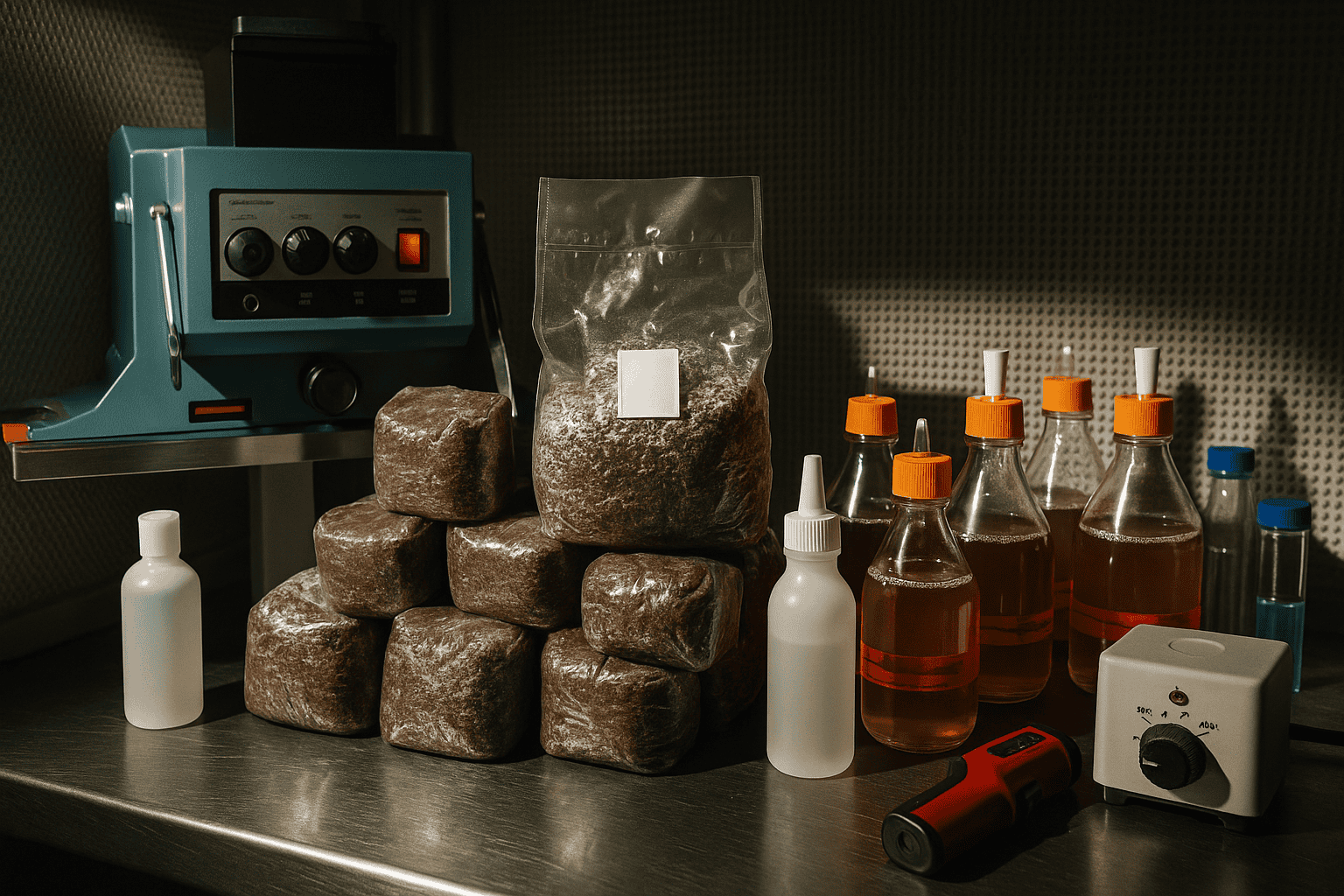
Your Sterile Workspace Arsenal
- Still Air Box (SAB) or Laminar Flow Hood: Your contamination-fighting fortress. A SAB is perfect for beginners—affordable and effective!
- 70% Isopropyl Alcohol: Your best friend for keeping surfaces squeaky clean
- Pressure Cooker or Autoclave: Essential for sterilizing water (15 PSI for 30 minutes does the trick)
- HEPA Air Purifier: Optional but helpful—think of it as your backup defense against airborne nasties
Syringe Components That Make the Magic Happen
- 10ml Luer-Lock Syringes: The Luer-Lock is key—no accidentally shooting needles across the room!
- 18-Gauge Needles: Perfect size for smooth spore dispensing without clogging
- Distilled or Deionized Water: Pure H2O is non-negotiable here
- Glass Beaker or Mason Jar: For sterilizing your water (grandma’s canning jars work great)
- Aluminum Foil: Creates a sterile barrier during sterilization
- Nitrile Gloves: Skip the powdered ones—that powder is contamination waiting to happen
- Face Mask: Because nobody wants to breathe contaminants onto their work
Spore Collection Essentials
- Spore Prints: Your spore source—foil prints are my personal favorite
- Sterile Scalpel or Knife: For the satisfying scrape of harvesting spores
- Magnetic Stir Bar: Optional, but super helpful for even distribution
The Step-by-Step Journey: From Spore Print to Perfect Syringe
Alright, this is where the rubber meets the road. I’ve prepared hundreds of syringes over the years, and while it might seem intimidating at first, you’ll quickly develop a rhythm. Remember: patience and attention to detail are your superpowers here.
Step 1: Creating Your Clean Room (Well, Clean Box)
First things first—let’s get that workspace sparkling. Grab your 70% isopropyl alcohol and give everything a thorough wipe-down. If you’re using a Still Air Box, pay special attention to the interior surfaces. Here’s a pro tip: after cleaning, let everything sit for 10 minutes. This gives the alcohol time to evaporate and any disturbed particles to settle.
Turn off anything that moves air—fans, AC units, even that desktop fan you forgot about. Close windows and doors. If you have a HEPA filter, fire it up 30 minutes before you start. The Institute of Environmental Sciences and Technology has shown that reducing airborne particles dramatically cuts contamination risk. Trust the science on this one!
Step 2: Sterilizing Your Water (The Foundation of Success)
Pour about 100ml of distilled water into your glass container—a mason jar works perfectly. Cover it tightly with aluminum foil, making sure to crimp the edges well. This little foil hat is going to protect your water during its pressure cooker spa treatment.
Into the pressure cooker it goes! Set it for 15 PSI and let it run for 30 minutes. Here’s where patience pays off: when it’s done, resist the urge to quick-release. Let that pressure drop naturally. I learned this the hard way—quick release can cause your water to bubble over and compromise that protective foil seal. Once it’s cool, remove your sterilized water and let it reach room temperature. Perfect time for a coffee break!
Step 3: Prepping Your Syringes (The Fun Part Begins)
Time to work in your sterile environment. Unwrap those fresh syringes and needles—but here’s the golden rule: don’t touch the business end of anything. Think of it like handling a photograph by its edges.
Draw about 10ml of air into each syringe and push it back out. This little exercise ensures your plunger moves smoothly when it counts. Twist on those needles with confidence (but gently—we’re not assembling furniture here), cap them, and set them on your clean surface. You’re doing great!
Step 4: Creating the Spore Suspension (Where Magic Meets Science)
This is my favorite part—where spore print meets water to create liquid gold for microscopy. Working smoothly but without rushing in your sterile space:
- Peel back that foil from your cooled, sterile water
- Flame-sterilize your scalpel until it glows (so satisfying!), then let it cool briefly
- Gently scrape spores from about a 1cm x 1cm area of your print into the water
- Give the container a gentle swirl—think wine tasting, not milkshake mixing
You’re aiming for a slightly cloudy appearance—like a very diluted milk. Too dark and your microscope slides will be overcrowded; too light and you’ll be hunting for spores like finding needles in haystacks. It takes practice, but you’ll develop an eye for it!
Step 5: Loading Your Syringes (Almost There!)
Here’s where steady hands shine:
- Keep that needle pointing up as you remove the cap (gravity is your friend)
- Slide the needle into your spore suspension at a slight angle
- Draw up 10ml slowly—rushing creates bubbles nobody wants
- Give the syringe a few gentle taps to free any air bubbles
- Push the plunger just until a tiny drop appears at the needle tip
- Cap that needle immediately—contamination waits for no one!
Step 6: The Finishing Touches (Quality Control Matters)
Label each syringe clearly with the species name, today’s date, and “For Microscopy Only.” This isn’t just good practice—it’s essential record-keeping. Store your new creations in a cool, dark place. Research shows that well-prepared spore syringes stay viable for microscopy for 12-24 months when kept at 2-8°C. Your refrigerator’s veggie drawer works perfectly!
Level Up: Advanced Techniques for the Ambitious
Once you’ve mastered the basics, you might want to explore some techniques the pros use. These aren’t necessary for great results, but they’re fun to experiment with.
Dialing In Spore Density Like a Pro
The sweet spot for microscopy is about 10-20 million spores per ml. Want to get precise? A hemocytometer lets you count like the labs do. The CDC has great training resources on this technique. Fair warning: it’s a bit nerdy, but incredibly satisfying when you nail it!
Building Your Research Library
Serious about your microscopy? Start documenting everything:
- Where and when you collected each specimen
- What the fruiting body looked like (photos help!)
- Spore print color and density
- Your microscopic measurements and observations
- Any quirks or unique features you notice
Trust me, future-you will thank present-you for keeping good records!
The Extra Mile: Testing for Perfection
Some researchers test a drop from each batch on agar to verify sterility. While this goes beyond pure microscopy work, it’s a great way to ensure your syringes are pristine for long-term storage.
Troubleshooting: Because Even Experts Hit Snags
Let’s be real—things don’t always go perfectly. Here’s how to handle the most common hiccups:
The Clumping Conundrum
Problem: Your spores are partying together in clumps instead of floating freely.
Solution: Drop in a sterile magnetic stir bar and give them a 5-10 minute spin on a stirrer. No stirrer? No problem! Draw the suspension in and out of the syringe several times. It’s like a microscopic massage that breaks up the clumps.
The Case of the Missing Spores
Problem: Your suspension looks like plain water—where are all the spores?
Solution: Fresh prints are your friend here. Older prints can lose viability, leading to disappointing results. Also, don’t be shy with your scraping—you need enough spores to create that telltale cloudiness. If your print looks sparse, use a larger area.
The Contamination Blues
Problem: Unwanted guests have crashed your spore party.
Solution: Time for a technique check-up. Common culprits include:
- Rushed workspace prep (patience, grasshopper!)
- Accidentally touching sterile surfaces
- Working too slowly and letting airborne contaminants settle
- Using water or equipment that wasn’t properly sterilized
Don’t beat yourself up—even experienced folks occasionally deal with contamination. Each mistake is a learning opportunity!
Choosing Winners: Selecting Quality Spore Sources
Great syringes start with great spores. Here’s what to look for when selecting your starting materials:
Signs of a Premium Spore Print
- Dark and Dense: Like a good espresso, richness matters
- Fresh is Best: Recent prints give you the most viable spores
- Clean Background: No weird spots, discoloration, or fuzzy bits
- Known Origin: Documentation helps with your research records
When to Consider Professional Sources
Sometimes it makes sense to start with professionally prepared syringes, especially when you’re learning. Our Golden Teacher spore syringes are particularly popular with microscopy enthusiasts, and the beginner mixpack offers great variety for comparative studies.
Making the Most of Your Microscopy Sessions
You’ve got your syringes—now let’s talk about getting those stunning microscopic views you’ve been dreaming about.
Preparing Picture-Perfect Slides
- Place just one drop of your suspension on a clean slide (less is more!)
- Add a drop of water or stain if you’re feeling fancy
- Lower that coverslip at a 45-degree angle—slow and steady wins the race against air bubbles
- Start at 100x to get oriented, then zoom in to 400x or 1000x for the jaw-dropping details
What to Look For Under the Lens
Following taxonomic guidelines from the Pacific Institute for Mathematical Sciences, here’s your observation checklist:
- Measure length and width (micrometers are your unit here)
- Note the shape—ellipsoid? spherical? something wonderfully weird?
- Check out surface features—smooth, warty, or ridged like tiny sculptures
- Observe color changes under different lighting
- Look for special structures like germ pores
Each species has its own microscopic signature—learning to recognize these is incredibly rewarding!
Staying on the Right Side of Science (and the Law)
Let’s talk about the legal landscape. In most U.S. states, Psilocybe spores are perfectly legal for microscopy because they don’t contain any controlled substances. It’s the cultivation that crosses legal lines, which is why we stick to microscopy.
Remember These Key Points:
- Your spore syringes are strictly for microscopy and taxonomy research
- Always check your local regulations—laws can vary
- Keep detailed records of your research activities
- Never attempt cultivation of prohibited species
- Embrace the genuine scientific value of taxonomic study
Spore Syringes vs. Other Methods: Choosing Your Tool
Wondering when to use spore syringes versus other research methods? Each has its place in the mycologist’s toolkit. Our comprehensive guide on spore syringes versus liquid cultures dives deep into these differences.
Why Spore Syringes Rock for Research
- Genetic Goldmine: Every spore is genetically unique—like snowflakes under your microscope
- Storage Champions: Properly made syringes stay viable for years
- Sharing Made Easy: Perfect for trading with fellow researchers
- Tough Cookies: Spores naturally resist many contaminants
Growing Your Microscopy Collection
Once you catch the microscopy bug (and you will!), you’ll want to expand your collection. Here are some classics that offer fantastic learning opportunities:
- B+ spores – Their large size makes them perfect for beginners learning to focus their scopes
- Penis Envy spores – Unique morphology that challenges your observation skills
- Blue Meanie spores – Prolific sporulators that ensure plenty of material to study
Your Journey Into Microscopic Wonders Begins Now
Creating spore syringes for microscopy is more than just following steps—it’s about developing a deep appreciation for the incredible diversity of the fungal kingdom. Each time you peer through that microscope, you’re seeing structures that have evolved over millions of years, each perfectly adapted to its role in nature.
Whether you’re making your own syringes or starting with professional ones, remember that you’re part of a long tradition of curious minds exploring the microscopic world. Every observation you make, every measurement you record, adds to our collective understanding of these fascinating organisms.
Ready to start your microscopy adventure? Check out our full selection of research-grade spore syringes or dive deeper into specific strains with our detailed strain spotlights. The microscopic world is waiting for you!
Remember: All spore syringes are for microscopy, taxonomy, and educational purposes only. Always research and comply with local regulations.
